
01
Independent opportunities
Market-specific engines evaluate their own setups rather than forcing one signal model across every instrument.
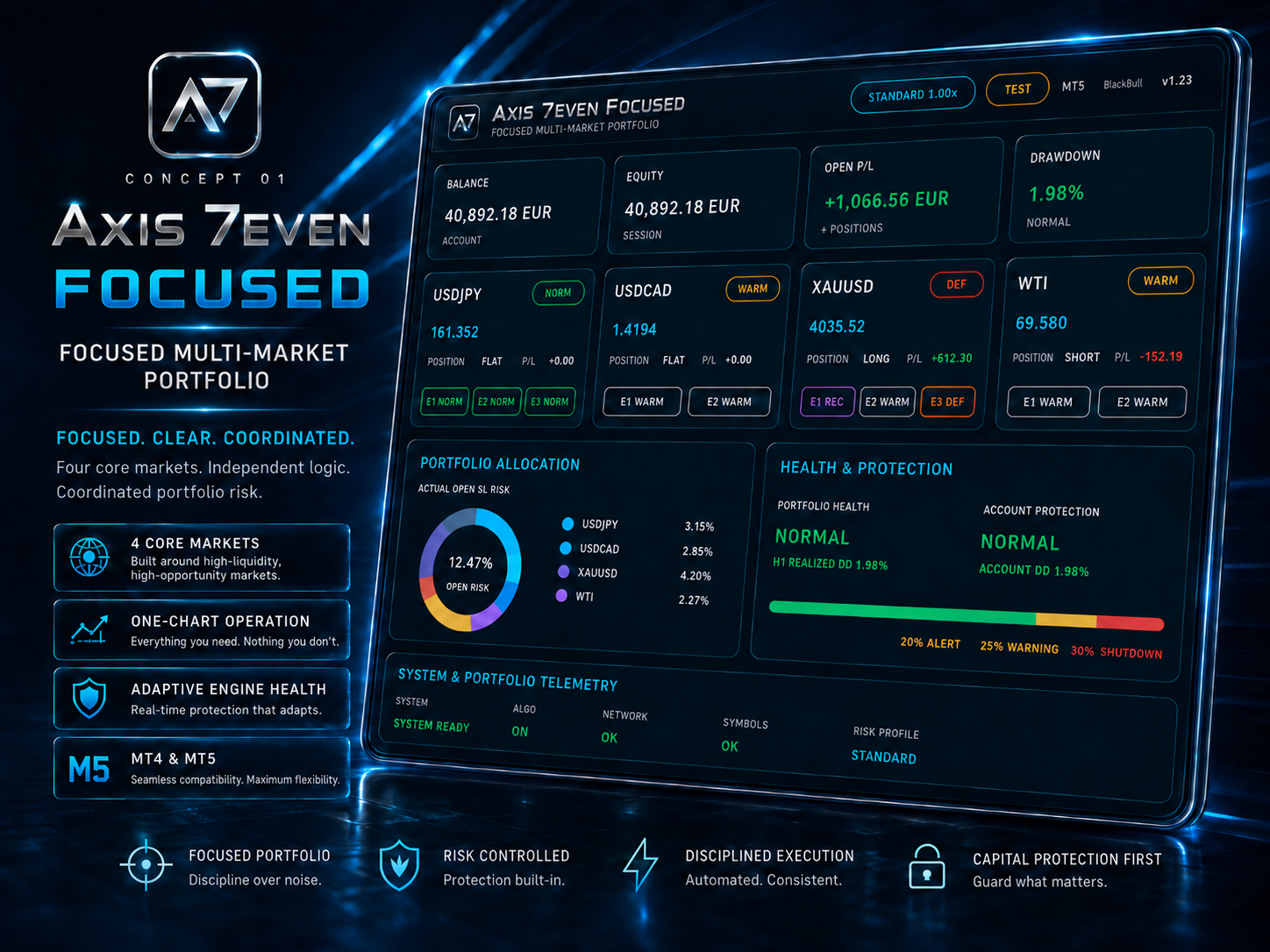
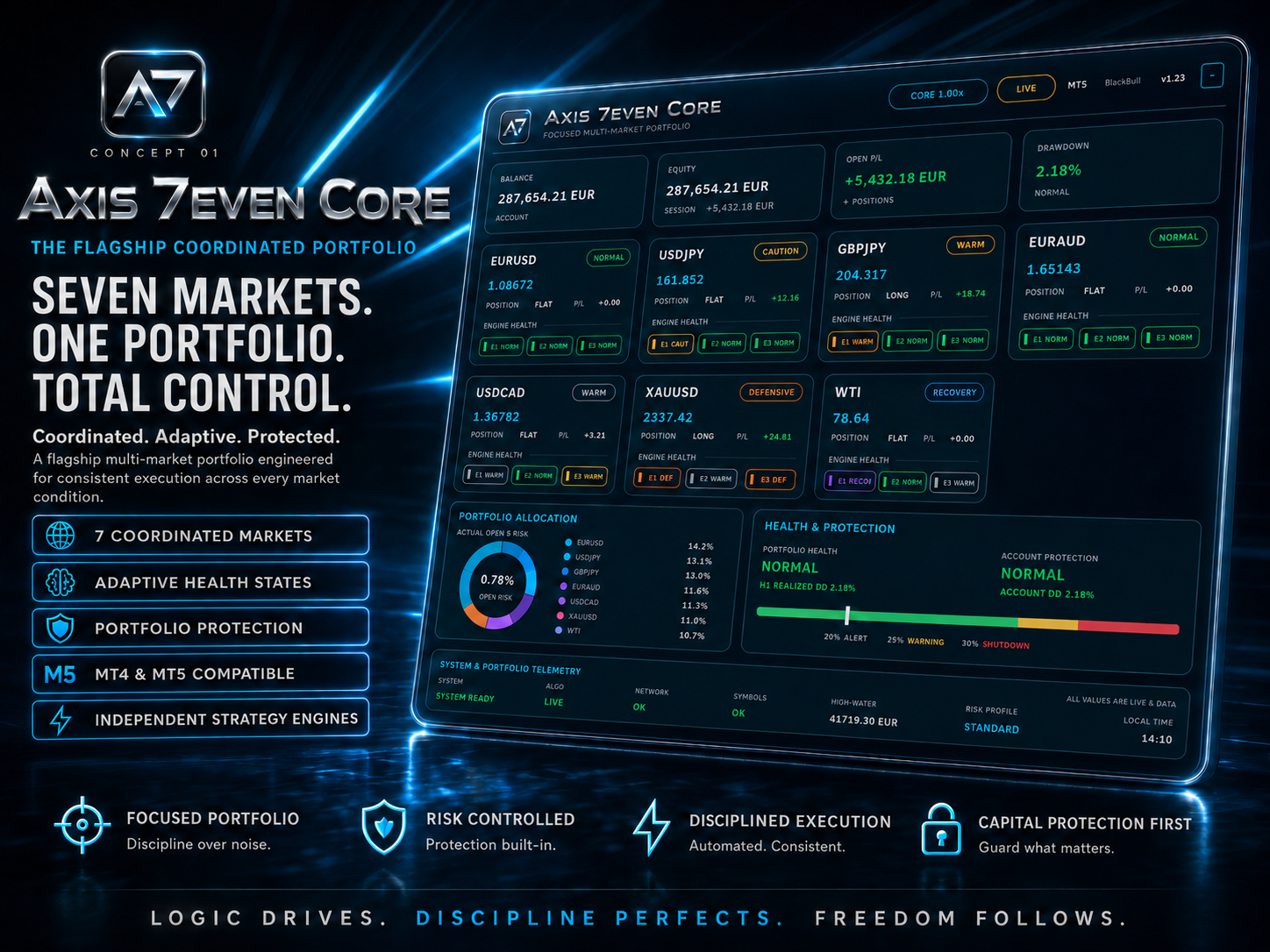
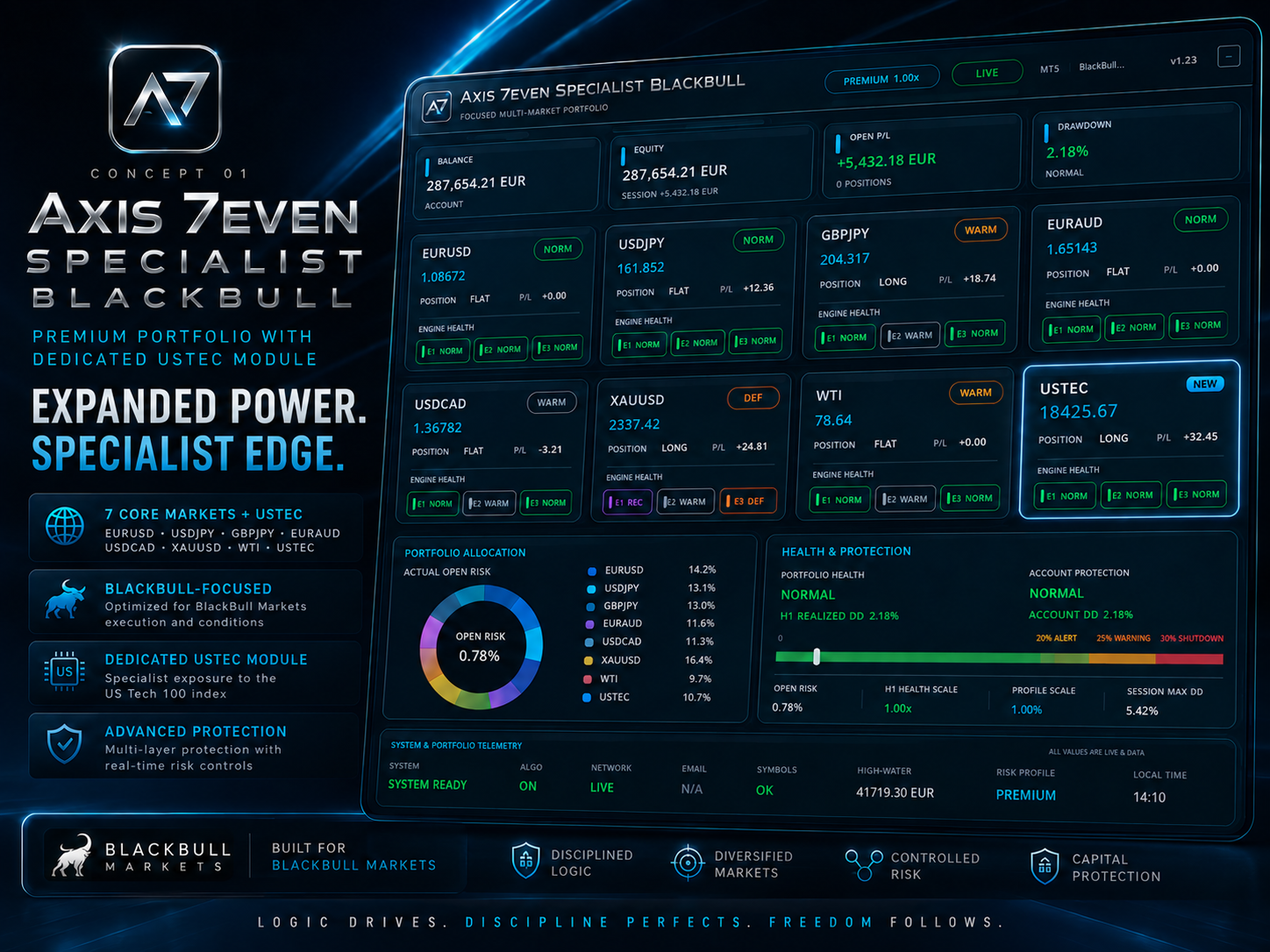
Multi-market portfolio family
Different markets. Different logic. One coordinated portfolio. Independent market-specific strategy engines operate under adaptive exposure control and layered account protection.
*USTEC M1 is exclusive to Axis 7even Specialist. BlackBull remains the publication reference; compatible non-reference broker instruments are supported when they pass the technical validation envelope.
Portfolio concept
Axis 7even does not treat every market as the same setup. Each market can contain one or more independent engines suited to different trading conditions, while shared controls coordinate balance, open positions, portfolio stress and account protection.
Market-specific engines evaluate their own setups rather than forcing one signal model across every instrument.
A trade in one market can affect the balance, exposure and protection state used when the next opportunity appears elsewhere.
Individual engine health and broader portfolio stress can reduce new exposure without requiring the entire system to stop.
Adaptive risk architecture
Axis 7even is a coordinated portfolio, not one monolithic strategy. Market engines identify opportunities independently, while the health, portfolio and account layers decide how much new exposure is appropriate at that moment.
Determines whether a valid opportunity exists for its market and strategy style.
Judges whether that specific strategy is currently behaving normally, weakening or recovering.
Responds when the realized H1 portfolio as a whole falls into a broader stress phase.
Tracks current equity against the account's highest realized balance and provides the final emergency guard.
Individual engine health
Each H1 engine tracks its own performance in normalized risk units. A weakening engine can be reduced without penalizing healthy engines elsewhere in the portfolio — and it keeps proving itself internally before full exposure returns.
WARMUP — Early operating phase while enough completed outcome history is being built. Severe early weakness can still trigger protection.
NORMAL — Recent and broader evidence remain within the acceptable operating range. The engine keeps its normal exposure under the selected Risk Profile.
CAUTION — Recent behaviour has weakened enough to justify intervention. New risk for this engine is reduced while the rest of the portfolio keeps its own state.
DEFENSIVE — The deterioration is stronger and broader evidence confirms it is not merely an isolated result. New exposure is reduced much more aggressively.
PAUSED — Sustained severe weakness blocks new real entries from that engine. Internal virtual tracking continues so recovery can still be measured.
RECOVERY — Recent evidence has improved enough to resume trading, but full confidence is not restored yet. The engine returns at reduced exposure until broader evidence also confirms recovery.
PORTFOLIO CORE
Tracks the realized H1 basket from its own high-water mark and acts on new H1 exposure only — separate from individual engine health and the account emergency guard.
Deterioration reacts as a stress boundary is reached. Recovery uses hysteresis, so the basket must improve meaningfully before stepping back to a less protective state. This reduces repeated switching around a threshold.
Account PROTECTION
Compares current equity with the highest realized account balance tracked by Axis. Floating losses matter to the decision even though the high-water reference comes from realized balance.
One notification for the current drawdown episode. Trading continues.
A stronger one-time warning for the same episode. Trading continues.
New entries are blocked after actual drawdown reaches the trigger. Existing managed positions are not force-closed; they continue to their normal exits.
The 30% trigger is latched. A later rebound does not simply reactivate entries. When all managed positions are flat, shutdown is finalized and preserved across restart. Because open positions can continue moving after the trigger, 30% is a protection trigger rather than a guaranteed maximum loss.
The selected Risk Profile sets the base scale. Engine health can reduce one strategy. PORTFOLIO CORE can reduce the H1 basket further. Broker lot rules and available margin are then checked before the order is sent. Protective layers can reduce exposure, but they do not increase it above the selected profile.
Read the Technical System Guide →Product family
Three portfolio architectures for different levels of market coverage and specialization. All three commercial editions are now available for MT4 and MT5.
A streamlined four-market portfolio — USDJPY, USDCAD, Gold and WTI — for disciplined, focused exposure.
The full seven-market coordinated portfolio — five FX pairs, Gold and WTI — run from a single chart.
Everything in the full portfolio, plus a dedicated intraday USTEC engine with a defined broker-compatibility envelope.
Historical research
Every edition is tested across multiple brokers and multiple years — not just backtested once and published. Full performance figures, drawdown, profit factor, trade counts and the USTEC broker-portability diagnostic are kept on their own page rather than crowding this one.
MT4 + MT5 architecture
The standard MT4 Strategy Tester uses one tested symbol as its active test context. Axis is different: a trade in one market changes shared balance, margin, open-position state and portfolio protection that can affect the next trade in another market. Testing each market separately and adding the profits would lose chronology, shared compounding, simultaneous exposure and cross-market state. MT5 can run the required markets inside one synchronized tester account, so it is used for the official multi-market portfolio performance reports.
Corresponding strategy functions, dependent inputs and shared portfolio/health logic were audited across the MT4 and MT5 commercial implementations.
On a controlled common historical input set, all trade-affecting candidates matched: 360/360 Focused and 468/468 Axis 7even, with no missing or extra candidates.
The chronological portfolio layer was replayed through filters, health, position state, shared balance, risk sizing and broker-step volume rounding. Focused matched 134/134 accepted entries and Core 200/200, with EUR 0.00 reconstructed realized-profit difference.
The Specialist MT4 edition carries the seven H1 markets plus the USTEC specialist, the same fixed New York session, broker-time mapping, Nasdaq compatibility gate and 0.01 lot/step requirement. In MT4 Strategy Tester, USTEC is validated as a single Nasdaq M1 run rather than as a synthetic full-portfolio total.
What this establishes: Focused and Core have completed controlled cross-platform parity evidence. Specialist is now available on both platforms and uses the same intended USTEC architecture and compatibility envelope, but the published multi-market performance and BlackBull/FxPro/NQ portability evidence remain MT5 reference evidence. Live MT4 and MT5 trades can still differ when broker candles, spreads, contract specifications, margin conditions or fills differ.
Read the validation methodologyDownloads
Product manuals cover installation and operation. The Technical System Guide explains the architecture and adaptive protection layers, while the Historical Testing & Validation Report provides the quantitative evidence set, annual-regime analysis, continuous compounding results and cross-platform validation summary.
Annual reset tests, four-broker 2026 robustness, BlackBull/Pepperstone continuous compounding, cross-tier analysis, matched USTEC research and MT4/MT5 validation evidence.
Open PDF → PDFSYSTEM GUIDEArchitecture, execution pipeline, engine health, PORTFOLIO CORE, account PROTECTION, broker normalization, annual/continuous statistics, USTEC compatibility, NQ portability evidence and MT4/MT5 platform behavior.
Open PDF → PDFMETHODOLOGYWhy a conventional MT4 tester report cannot represent the complete synchronized portfolio and how the MT4 editions were validated through parity and synchronized replay.
Open PDF →Installation, setup, risk profiles, dashboard states, operating guidance and troubleshooting for MT4 and MT5.
Open PDF → PDFUSER MANUALFull seven-market product manual for MT4 and MT5.
Open PDF → PDFUSER MANUALMT4 + MT5 manual for the seven-market H1 portfolio, USTEC intraday specialist, broker compatibility checks and operating requirements.
Open PDF →FAQ
No. Historical performance is evidence, not a guarantee. Trading leveraged instruments involves risk.
They are individual strategy-engine health states. Axis can reduce one engine when its recent behaviour weakens, pause new real entries under sustained weakness, and later return it through RECOVERY at reduced exposure. Healthy engines keep their own state.
At 20% Axis can send an alert; at 25% a stronger warning. At an actual 30% drawdown trigger, new entries are blocked. Existing managed positions continue under their normal strategy management until flat, after which shutdown is finalized. The trigger is not a guaranteed maximum loss.
Yes. Focused, Core and Specialist are available on MT4 and MT5. Focused and Core have completed the controlled cross-platform parity framework. Specialist MT4 uses the same intended USTEC session and compatibility architecture; official synchronized portfolio reports and the current BlackBull/FxPro/NQ USTEC portability evidence remain MT5 reference evidence because MT4 cannot natively reproduce the complete multi-market portfolio test.
The standard MT4 Strategy Tester cannot natively reproduce the complete synchronized multi-market portfolio with shared chronology, balance, margin, positions and portfolio state. MT5 provides the multi-market tester environment required for the official portfolio report, while the MT4 implementation is validated separately.
No. BlackBull remains the frozen publication reference, but Specialist can operate on another compatible broker instrument when the Nasdaq contract passes the technical gate: minimum volume and volume step no larger than 0.01 lot, normalized minimum stop distance no greater than 20 Nasdaq index points, full trading with market orders and SL/TP, USD profit currency, valid tick/contract/margin data, sufficient M1 history and correct New York session mapping. Cross-broker signals can differ because feeds are not identical.
Because win rate alone says little about profitability. Expectancy depends on the size of winners, the size of losses and how much risk is taken when conditions change.
Return without risk context is incomplete. We present drawdown and other quality measures because the path to a result matters.
Commercial releases are distributed through the MQL5 Market. Product-specific requirements and documentation are provided with each listing.
Axis 7even
Compare the Focused, Core and Specialist editions, then review the documentation before installation.